

- Cloud: Advanced settings in the Resolve page for a cloud-based integration
- Satellite: Data redaction capabilities with standard regexes
- Sidecar: Deploy alongside the satellite to customize redaction logic
Data Subject to Redaction
The following categories of sensitive information are subject to redaction:- Logs: Entire raw log messages.
- Spans / Traces: Attributes and tags.
- Metrics: All metric names and label values.
Redacted Data Patterns
Redaction is based on a list of regex expressions on common sensitive data. See the full list below:- Phone number
- DOB
- Credit card number
- Bank account
- Card expiration date
- SSN
- EIN
- IP Address
- US street address
Option 1: Redaction for Cloud Integrations
Sensitive data redaction can be enabled on a per integration basis.- Open the desired integration, such as Datadog.
- Enable the Redaction Config within the integration settings.
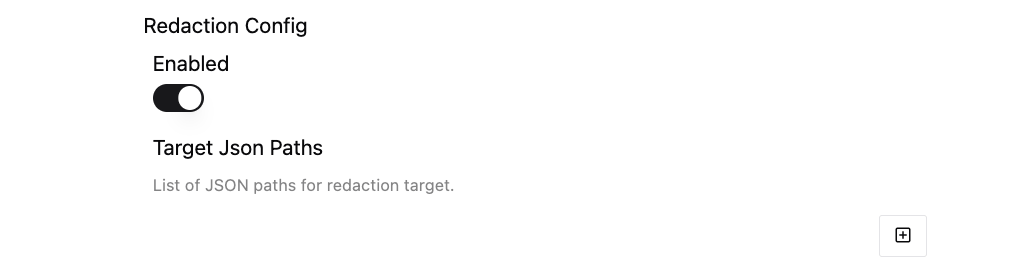
- By default, ResolveAI redacts the all JSON paths listed in the “Supported data types and observability platforms” section above.
- You can also specify additional custom target JSON paths to redact as needed. E.g;
$.data[*].attributes.spans[*].mytags..*
Option 2: On-Prem Redaction from Satellite Sidecar
Sensitive data redaction can be enabled on a per integration basis from the Resolve Satellite.Prerequisites
- The Resolve Satellite should already be installed in your environment. If you need assistance with installation, refer to the instructions provided in Resolve Satellite section.
- If you need assistance with the installation, refer to the instructions provided in the respective observability tool integration documentation.
- The specific integration you want to redact data for should be set up through the Resolve Satellite.
Update integration configuration
Update your helm values override file (ex:resolve-values.yaml) with the redactionConfig configuration for a specific integration (ex. grafanaOnPrem).
resolve-values.yaml
resolve-values.yaml). Visit DockerHub for the latest Helm chart and satellite.
apply config to satellite and redeploy
Verify redaction is enabled
Login to https://app0.resolve.ai/. Go to the integrations page and and select the integration for which you enabled sensitive data redaction. You should see an automatically created integration based on the provided configuration, including whether redaction is enabled.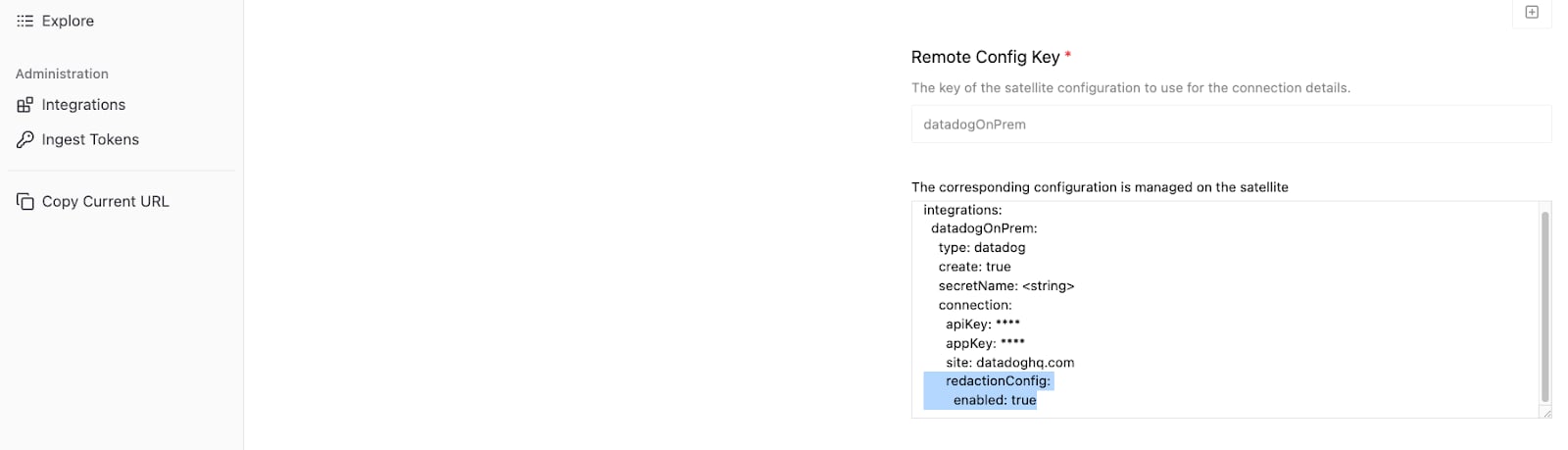
Security Sidecar
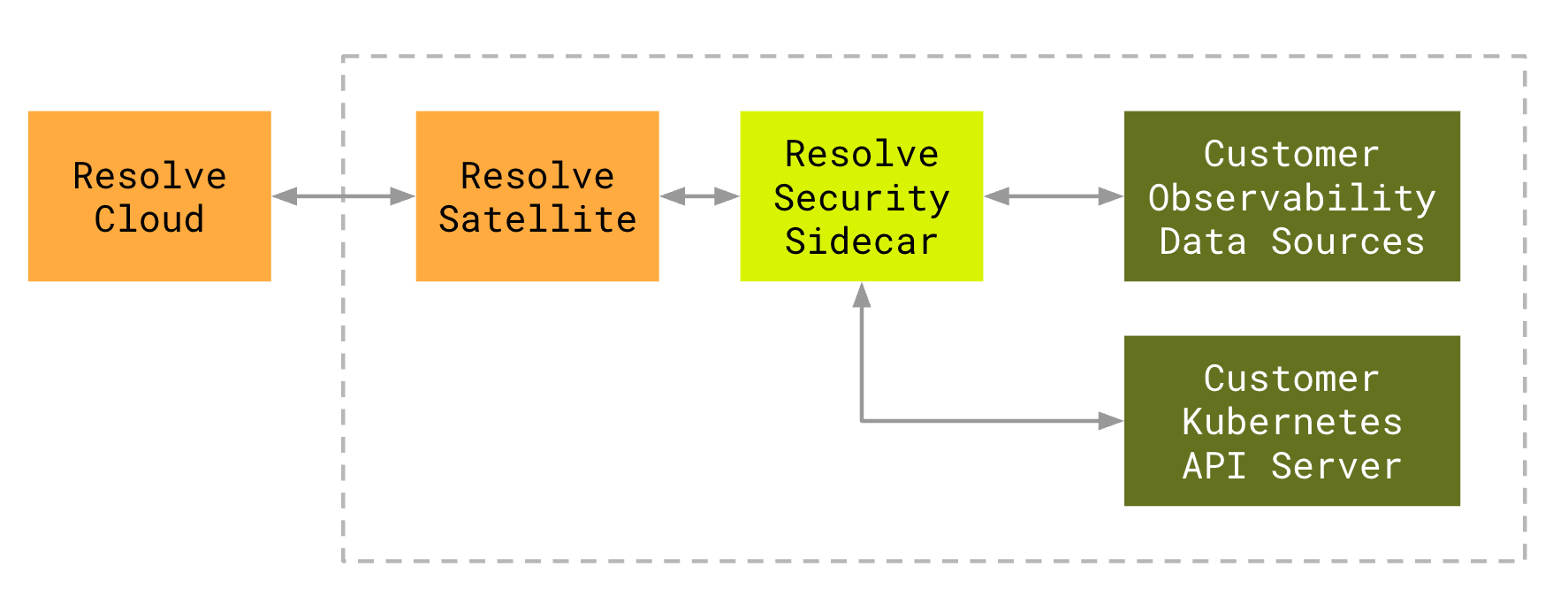
The Security Sidecar is a lightweight HTTP proxy container deployed alongside the Resolve Satellite in the same pod. It provides two capabilities beyond what the ResolveAI web app offers by default:- Secret resolution — Resolves Kubernetes secrets into HTTP headers before requests leave the pod, so the satellite process never sees raw API keys
- Response redaction — Strips sensitive data (credit cards, emails, SSNs, etc.) from API responses before the satellite processes them
- Auditable redaction logic — Source code is available for review and customization (contact help@resolve.ai to request access)
How It Works
Secret Resolution
Integration credentials can be stored as placeholders (e.g.,$.load.DATADOG_API_KEY) in the satellite’s integration config instead of plain-text values.
- The satellite sends outbound HTTP requests through the sidecar proxy running in the same pod
- The sidecar detects headers containing the
$.load.prefix - For each match, the sidecar resolves the actual secret value from a Kubernetes secret (injected as an environment variable or mounted as a file)
- The sidecar replaces the placeholder with the resolved value and forwards the request to the target service
Response Redaction
On the return path, the sidecar applies regex-based redaction to API response bodies before they reach the satellite. This uses the same patterns listed in the Redacted Data Patterns section above. Redaction is enabled by default and controlled by theENABLE_REDACTION environment variable.
Prerequisites
- The Resolve Satellite is already installed in your environment
- At least one on-prem integration is configured through the satellite
Install the Security Sidecar
1. Update Values File
Add thesidecarProxy block to your resolve-values.yaml:
resolve-values.yaml
2. Configure Secrets
UsesecretKeyRefs to make Kubernetes secret values available to the sidecar. Each entry maps a key from a Kubernetes secret to an environment variable name that corresponds to a $.load.<name> placeholder in your integration config.
For example, to resolve Datadog API and App keys:
resolve-values.yaml
$.load.DATADOG_API_KEY in the satellite’s integration config will be resolved to the value of the apiKey key in the datadog-resolve-token Kubernetes secret. The satellite itself never sees the raw credential.
Advanced: Mount secrets as files
Advanced: Mount secrets as files
As an alternative to environment variable injection, secrets can be mounted as files. This may be preferable when using external secret store CSI drivers, or to prevent secrets from appearing in the container’s environment (e.g., Then mount it in your The integration config uses the same
kubectl describe pod output).The secret keys must match the $.load placeholders exactly.First, create the Kubernetes secret. The key names must match the $.load placeholders you use in your integration config:datadog-resolve-token.yaml
resolve-values.yaml:resolve-values.yaml
$.load.DATADOG_API_KEY and $.load.DATADOG_APP_KEY placeholders as the environment variable approach.3. Apply Changes
Update the satellite with the newresolve-values.yaml file.
4. Verify the Sidecar is Running
Confirm that the pod has two containers (satellite and sidecar-proxy):
Full Example
Below is a completeresolve-values.yaml that enables the sidecar with secret resolution for a Datadog on-prem integration:
resolve-values.yaml