

To get access to the ResolveAI application, request a demo.
Connect Resolve to Slack
1. Install Application
- Log in to the ResolveAI App at app0.resolve.ai
- Open the App Integration page
- Add a Name and click Install Application
- In Slack, pick your workspace in the top right corner and click Allow
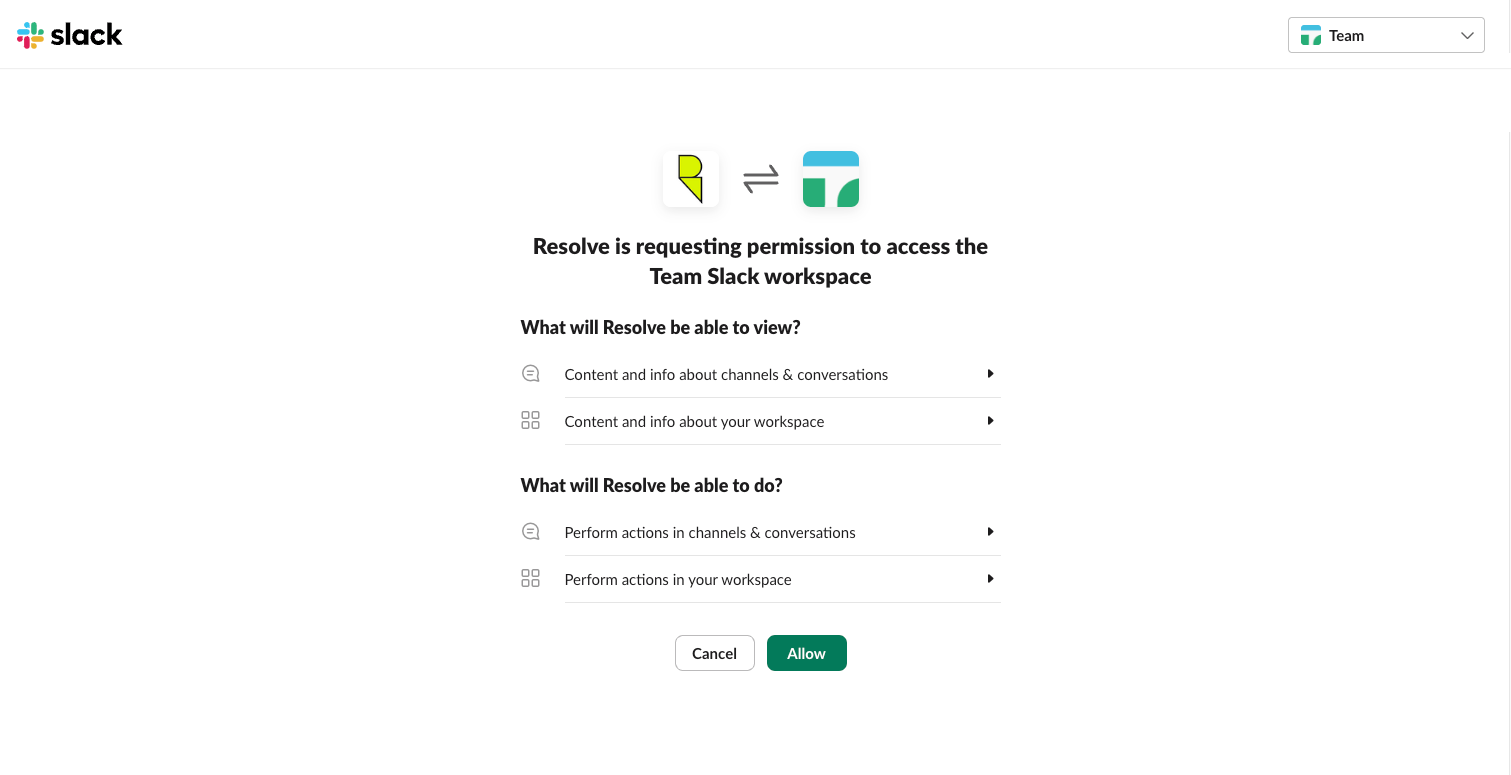
2. Invite Resolve App
- Open your alerts channel, ex. #monitoring-alerts-webstore
- Type
/addand click Add apps to this channel - Search Resolve and click Add
3. List the channels Resolve is monitoring
After adding the Resolve app to the channel, run the command/resolve list
App Scopes
App Scopes
The Resolve app for Slack requests these bot token scopes:
All scopes below are required except
If you decline it during install, you can add Resolve to channels manually or use another Slackbot to add it for you.
channels:join, which is optional and on by default. It lets Resolve join channels you ask it to via incident webhooks or Team settings. If you decline it during install, you can add Resolve to channels manually or use another Slackbot to add it for you.
It also requests one user token scope:
How It Works
Overview
ResolveAI brings intelligent, AI‑driven incident response into Slack. It connects to observability tools and infrastructure, like Datadog, Grafana, Kubernetes, GitHub, etc., and helps your team react faster, investigate more effectively, and shorten MTTRProblems We Solve
SRE teams face alert fatigue and long resolution cycles. ResolveAI automates triage, provides first‑pass root‑cause theories, and integrates seamlessly with Slack to reduce cognitive load and accelerate incident response.Features & Interactions
1. Ask Resolve in Slack
You can work with Resolve directly in Slack by mentioning@Resolve in the channels where your team collaborates. Resolve can answer questions, investigate active issues, summarize findings, and link back to the full investigation in Resolve.
2. Auto-Investigations
Resolve also supports alert-driven workflows in Slack. When an alert message appears in a configured team alert channel, Resolve can recognize it, match it to the underlying alert, and reply with investigation updates in Slack. Auto-investigations are configured at the team level. To activate them:- In ResolveAI, open Team Knowledge.
- Click the team you want to investigate alerts for, or create a new team.
- Go to the tab Alerts.
- Create an alert filter for just the important alerts to investigate.
- Turn on the toggle Auto-Investigate for this filter, and save.
- Now that auto-investigations are on, Resolve will automatically investigate new alerts that match these filters.
- If you want Resolve to respond inside Slack when those alerts appear there, also go to Slack channels and add the relevant channel as an Alert channel.
- When Resolve sees an active alert that matches one of your team’s auto-investigation filters, it can automatically start an investigation for that alert.
- If the same alert is also posted into a Slack channel your team has configured as an Alert channel, Resolve can match the Slack message to that alert and respond in Slack with investigation progress and follow-up updates.
- Alerts with no matching filter, or with auto-investigation disabled, are not auto-investigated. They can still be manually investigated by replying in the Slack thread
@Resolve /rca.
- Alert filters decide which alerts Resolve should investigate.
- Slack alert channels decide where Resolve can see and respond to alert messages in Slack.